www.aljazeerah.info
2026 News
Archives
Mission & Name
Conflict Terminology
Editorials
Gaza Holocaust
Gulf War
Isdood
Islam
News
News Photos
Opinion Editorials
US Foreign Policy (Dr. El-Najjar's Articles)
www.aljazeerah.info
|
Editorial Note: The following news reports are summaries from original sources. They may also include corrections of Arabic names and political terminology. Comments are in parentheses. |
***
As Nuclear Talks Going on, Iran Is Preparing for a Long War, US Top General Dan Caine Warns of a Prolonged Conflict and Potential American Casualties
February 24, 2026
***
 |
|
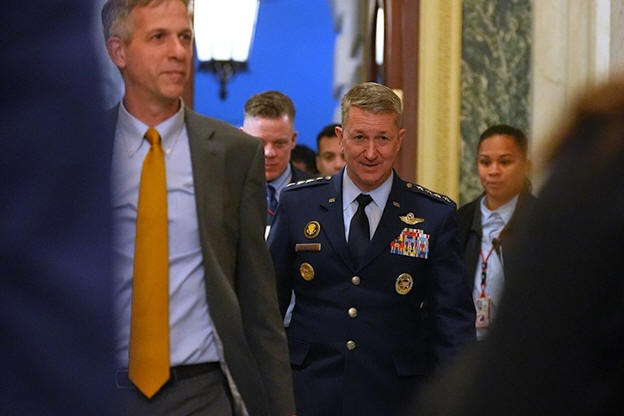
| US Joint Chiefs Chairman, General Dan Caine, reportedly warned Trump that striking Iran could lead to prolonged conflict and potential American casualties, Feb 23, 2026. | |
***
Iran may be preparing for long war with US: Responsible Statecraft
By Al-Mayadeen, February 24, 2026
After Operation Midnight Hammer, Iran appears prepared to expand the US-Iran war into a prolonged regional conflict, betting that Washington seeks to avoid full-scale escalation while nuclear talks continue.
According to an analysis published by Responsible Statecraft and written by Sajjad Safaei on February 23, 2026, Iran may be preparing for a prolonged regional confrontation with the United States, betting that Washington lacks the political will for sustained escalation.
Trump’s decision in June 2025 to bomb Iran’s nuclear facilities in the final days of "Israel’s" war on Iran removed any lingering doubts about his administration’s willingness to cross the longstanding US red line of directly attacking Iran’s nuclear program.
The operation, dubbed Operation Midnight Hammer, fundamentally altered the strategic landscape of the US-Iran war. Every subsequent American military threat carried enhanced credibility rooted in precedent. The US military’s abduction of Venezuelan President Nicolás Maduro in January only reinforced that perception.
Yet the June attacks also triggered consequences that complicate Trump's Iran policy and Washington’s broader approach toward Iran’s nuclear program.
Operation Midnight Hammer and the new phase of the US-Iran war
According to the analysis, the brief US-Iran escalation following Operation Midnight Hammer sent a dual message to Tehran. While Washington demonstrated a readiness to use force, it also signaled reluctance to enter a prolonged and costly confrontation.
The Trump administration had warned that any Iranian retaliation would provoke devastating consequences. However, after Iran launched ballistic missiles at US bases in Qatar, Trump reframed the episode as an opportunity to move toward “peace and harmony.” This was followed by his brokering of a ceasefire between Iran and "Israel."
For Iranian decision-makers, this episode suggested that while the US might initiate high-impact strikes, it remained wary of open-ended escalation. That perception now shapes the trajectory of the US-Iran war.
Why Iran no longer fears total war
The joint US-Israeli war on Iran in June 2025 produced a deeper psychological shift in Tehran.
In the years preceding the 12-Day War, Iranian leadership operated under the belief that total war could and should be avoided at nearly any cost. That caution deterred Iran from retaliating decisively against repeated Israeli strikes, even as those strikes grew increasingly bold.
The events of June 2025 dismantled that strategic restraint. Iran’s leadership concluded that it was no longer standing at the brink of a preventable war but had already entered a recurring cycle of limited US and Israeli wars on its own territory.
From Tehran’s perspective, avoiding escalation no longer guarantees security. Instead, it invites further pressure, the article concluded.
Iran’s strategy: expanding the US-Iran war into a regional conflict
Iran’s generals appear to have reached a stark conclusion. The only reliable way to break the cycle of limited strikes is to expand the confrontation beyond Washington’s preferred model of swift, controlled military interventions.
As Iran’s Supreme Leader Ali Khamenei recently warned, “If they start a war this time, it will be a regional war.”
This reflects a structural asymmetry in resolve. The argument is not that Iran’s armed forces match the capabilities of the US military. Rather, Tehran may possess a higher tolerance for sustained confrontation.
In this sense, the US-Iran war may hinge less on military hardware and more on endurance. The militarily weaker party can sometimes absorb and impose costs more persistently, resulting in a strategic posture less favorable to the stronger power than raw military balance might suggest.
Paradoxically, this hardened Iranian posture has emerged at a moment of regional vulnerability. The collapse of Assad’s rule in Syria and the weakening of Hezbollah’s operational depth in southern Lebanon have narrowed Iran’s strategic cushion. Yet instead of retreat, Tehran appears to have embraced full mobilization for the possibility of a regional war.
Trump Iran policy and the return of US-Iran nuclear talks
Rather than signaling that Washington has successfully coerced Tehran, the resumed talks may highlight the limited choices facing the US, the article argue.
The Trump administration is confronted with a stark dilemma: it can escalate toward a full-scale war, whose course and consequences could quickly move beyond US control, or it can opt for a negotiated resolution to the nuclear dispute.
If the current discussions lead to an agreement, it would suggest that US policymakers have recognized the unpredictable and potentially catastrophic costs of all-out war with Iran.
Had Trump believed the United States could swiftly and decisively defeat Iran on its own terms, he would likely already have pursued that course, as he did with the operation targeting Venezuelan President Nicolás Maduro.
What has constrained Washington is Iran’s ability to compel the US and the wider region into a protracted war of attrition that could significantly accelerate the decline of US global influence.
War or nuclear settlement: Washington’s strategic dilemma
The present impasse is not new. Its core features were visible even before Trump withdrew from the JCPOA. President Obama’s pursuit of nuclear diplomacy was shaped by the same military realities that continue to constrain Trump's Iran policy today.
Nearly five decades after the 1979 Islamic Revolution, Washington’s options appear clearer than ever. One path leads to a total regional war whose limits would not be set by Washington. The other leads to a nuclear settlement that, while imperfect from Trump’s perspective, would pull the US back from the brink of open-ended regional confrontation.
If Washington’s participation in the Israeli June 2025 war elevated military force as a central tool of US-Iran war strategy, a successful diplomatic outcome would formally undermine that logic.
But if negotiations collapse, the next confrontation will not resemble June 2025. The Iran of today appears reconciled to the possibility that a decisive and painful confrontation may be preferable to chronic strategic vulnerability.
Iran may be preparing for long war with US: Responsible Statecraft | Al Mayadeen English
***
***
Iran nuclear talks: Gharibabadi warns against war
By Al-Mayadeen, February 23, 2026
During ongoing Iran nuclear talks in Geneva, Kazem Gharibabadi warned that Iran will not initiate war but will defend its sovereignty while reaffirming its right to peaceful nuclear energy.
Iran nuclear talks remain at the center of rising US-Iran tensions, as Tehran reiterates both its commitment to diplomacy and its readiness to defend its sovereignty.
Speaking at the United Nations, Iran’s Deputy Foreign Minister Kazem Gharibabadi stressed that while Iran does not seek confrontation, it will firmly respond to any aggression.
Iran will not initiate war, Gharibabadi says
Iran’s Deputy Foreign Minister, Kazem Gharibabadi, said Monday that “Iran will not be the initiator of any war, but it will strongly defend its sovereignty,” adding, “Enemies may be able to start a war against Iran, but they will not be able to end it.”
Gharibabadi noted that “the consequences of a war against Iran would not be limited to the two parties involved.”
Speaking during a Human Rights meeting at the United Nations headquarters, he said that “Iran’s enemies were defeated in their aggression, so they sought to pave the way for another military attack by stirring chaos and unrest and hijacking peaceful protests.”
He stressed that “Iran and the Iranian people will firmly stand against any conspiracy.”
Iran’s right to peaceful nuclear energy is non-negotiable
Reaffirming Iran’s nuclear energy rights, Gharibabadi stated that the Islamic Republic of Iran’s right to peaceful nuclear energy is inherent, non-negotiable, and guaranteed under international law. He emphasized that this right cannot be arbitrarily suspended or denied.
The remarks come amid ongoing Iran nuclear talks and renewed debate over Iran-US negotiations concerning a potential nuclear agreement.
Iran reiterated its commitment to diplomacy and dialogue as the primary path toward de-escalation and sustainable security. Officials noted that the ongoing Geneva nuclear talks, which will continue next Thursday, present a new opportunity to address differences and build trust.
Tehran stressed that progress in the Iran nuclear talks depends on negotiations being conducted on the basis of mutual respect, fair treatment, and the non-selective application of international standards.
US signals readiness for new round of talks
On Tuesday, a senior US official told Axios that the United States is prepared to hold another round of talks with Iran next Thursday in Geneva “if it receives a detailed Iranian proposal for a nuclear agreement within the next 48 hours.”
As diplomatic engagement resumes in Geneva, the trajectory of the Iran nuclear talks may prove pivotal in determining whether tensions ease or escalate in the coming weeks.
Regional military escalation and US threats against Iran
The region is currently witnessing an unprecedented military buildup, alongside speculation about the possibility of carrying out an attack against Tehran. The broader regional military escalation in the Middle East has intensified tensions across several fronts, increasing diplomatic and security sensitivities.
On Friday, Iran’s Mission to the United Nations warned that recent statements by US President Donald Trump indicate a real risk of military aggression against Iran that could trigger catastrophic consequences across the region.
In a letter obtained by RIA Novosti, the mission said the current build-up of US military assets and equipment, combined with “belligerent” rhetoric from Washington, should not be dismissed as mere political messaging.
The letter stated that such remarks "signal a real risk of military aggression, the consequences of which would be catastrophic for the region and would constitute a grave threat to international peace and security."
Iran's allies, including the Islamic Resistance in Lebanon - Hezbollah and Russia, warned that any aggression on Iran would escalate into a large-scale regional conflict.
Iran nuclear talks: Gharibabadi warns against war | Al Mayadeen English
***
***
US general warns Trump of Iran strike risks amid military buildup
By Al-Mayadeen, February 23, 2026
US Joint Chiefs Chairman, General Dan Caine, reportedly warned Trump that striking Iran could lead to prolonged conflict and potential American casualties.
US Joint Chiefs of Staff Chairman Dan Caine has warned President Donald Trump that a potential military strike on Iran could draw the United States into a prolonged conflict, according to a report by Axios citing informed sources.
The report said Caine cautioned that such an operation could entangle Washington in an extended confrontation with Tehran, increasing the risk of escalation across the region.
According to the sources cited by Axios, Caine also warned that military action against Iran could result in US casualties.
Despite raising concerns, the chairman reportedly told Trump that he would support and implement any decision ultimately taken by the president regarding a possible strike.
The reported warning comes amid ongoing debate within Washington over how to address tensions with Iran, as policymakers weigh diplomatic options against potential military action.
Trump escalates Iran threat
US President Donald Trump has pushed the United States closer to a potential war with Iran, ordering a major military buildup and raising the prospect of an extended air campaign even as advisors warn that escalation could distract from economic messaging ahead of this year’s midterm elections.
The Trump administration’s posture has sharpened US-Iran tensions across West Asia, where US forces have expanded their presence amid warnings of strikes tied to Iran’s nuclear program. Yet Trump has not publicly presented a detailed case for war, leaving questions about strategic goals, escalation risks, and how Washington would manage regional fallout.
Trump has ordered a substantial deployment of US forces to West Asia, including aircraft carriers and warplanes, as the administration prepares for the possibility of a multi-week air attack on Iran.
A senior White House official said that despite Trump’s rhetoric, there was still no “unified support” within the administration to go ahead with an attack on Iran. The official said advisors are also concerned about sending a “distracted message” to undecided voters who are more focused on domestic economic concerns.
A regional flashpoint with high escalation risk
Trump’s fixation on Iran has emerged as the starkest example of how foreign policy and the expanded use of military force have dominated his agenda in the first 13 months of his second term, often overshadowing domestic issues such as the cost of living.
The administration’s intensified military posture comes after the US targeted nuclear sites in Iran in June, and Iran threatened to retaliate fiercely if attacked again. Trump has repeatedly warned of strikes if Iran does not reach an agreement on its nuclear program, and on Friday, he renewed the threat, saying Tehran “better negotiate a fair deal.”
The reasons Trump has given for potential military action have been vague and varied. He had initially threatened strikes in January in reaction to the Iranian government’s handling of the foreign-backed riots. More recently, Trump has tied threats to demands that Iran end its nuclear program and has floated the idea of “regime change,” but neither he nor his aides have explained how air strikes could achieve that.
The second White House official insisted that Trump “has been clear that he always prefers diplomacy, and that Iran should make a deal before it is too late.” The official added that the president has stressed Iran “cannot have a nuclear weapon or the capacity to build one, and that they cannot enrich uranium.”
US general warns Trump of Iran strike risks amid military buildup | Al Mayadeen English
***
Fair Use Notice
This site contains copyrighted material the
use of which has not always been specifically authorized by the copyright
owner. We are making such material available in our efforts to advance
understanding of environmental, political, human rights, economic,
democracy, scientific, and social justice issues, etc. We believe this
constitutes a 'fair use' of any such copyrighted material as provided for
in section 107 of the US Copyright Law. In accordance with Title 17 U.S.C.
Section 107, the material on this site is
distributed without profit to those
who have expressed a prior interest in receiving the included information
for research and educational purposes. For more information go to: http://www.law.cornell.edu/uscode/17/107.shtml.
If you wish to use copyrighted material from this site for purposes of
your own that go beyond 'fair use', you must obtain permission from the
copyright owner./font>
|
||||||||||||||||