www.aljazeerah.info
2026 News
Archives
Mission & Name
Conflict Terminology
Editorials
Gaza Holocaust
Gulf War
Isdood
Islam
News
News Photos
Opinion Editorials
US Foreign Policy (Dr. El-Najjar's Articles)
www.aljazeerah.info
|
Editorial Note: The following news reports are summaries from original sources. They may also include corrections of Arabic names and political terminology. Comments are in parentheses. |
***
First Round of Iran-US Talks in Pakistan Ends After Exchanging Bottom-Line Positions and Texts
April 12, 2026
***
 |
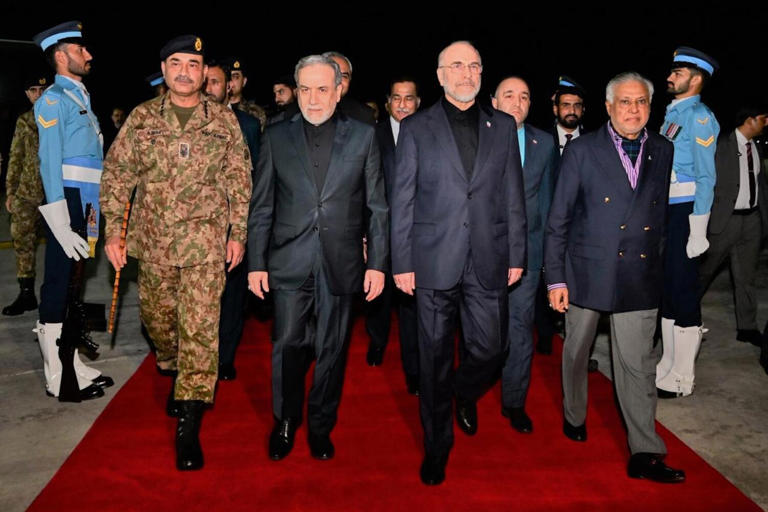 |
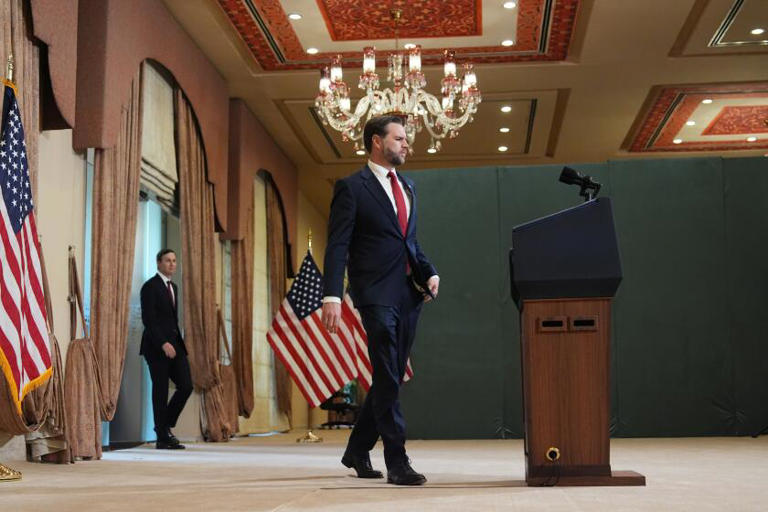
| Vice President JD Vance and Jared Kushner, left, arrive for a news conference, after meeting with representatives from Pakistan and Iran on Sunday in Islamabad, April 12, 2026 | Iran's Parliament Speaker, Mohammad Bagher Qalibaf, center right, and FM, Abbas Araghchi, center left, greeted by Pakistan Foreign Minister, Ishaq Dar, right, upon their arrival at Pakistan, on April 11, 2026 |
***
Qalibaf: US Failed to Earn Trust in Islamabad Talks despite Iran’s Proposals
April, 12, 2026 - 13:24
Speaker of the Iranian Parliament Mohammad Baqer Qalibaf stated that while Iran put forth several forward-looking initiatives during the Islamabad talks on April 11, the United States ultimately failed to gain the trust of the Iranian negotiators.
“I emphasized before the negotiations that we have the necessary goodwill and intention, but due to the experiences from the previous two wars, we do not trust the other side,” Qalibaf said in a post on his X account on Sunday.
“My colleagues in Iran’s Minab-168 delegation presented forward-looking initiatives, but the other side ultimately failed to gain the trust of the Iranian delegation in this round of negotiations,” he added.
“The United States understood our logic and principles, and now it is time to decide whether it can earn our trust or not,” Qalibaf noted.
“We believe that diplomacy of power is another approach alongside military struggle for the realization of the rights of the Iranian people, and we will not cease our efforts to consolidate the achievements of forty days of national defense by the Iranians for a moment,” he said.
“I appreciate the efforts of our friendly and brotherly country, Pakistan, for facilitating the process of these negotiations, and I send greetings to the people of Pakistan,” the Parliament speaker noted.
Qalibaf also lauded the “heroic people of Iran” for being present in the streets and praying the negotiators, and appreciated the Iranian negotiators for their tireless efforts during intensive 21-hour negotiations in Pakistan.
***
Exclusive: US Team Raises Excessive Demands as Talks Enter Text Exchange Stage
April, 11, 2026 - 21:46
The US team of negotiators has made excessive demands as the negotiating teams in Islamabad entered the text exchange stage, according to Tasnim’s correspondent in Islamabad.
“While after in-person expert talks between the Iranian and American delegations in Islamabad, the two sides had advanced to the text exchange stage to reach a common framework for negotiations, the American delegation has hindered the progress of the process by its recurring excessive demands,” Tasnim correspondent in Islamabad reported.
The consultations are still ongoing, but Iran insists on preserving its military achievements and emphasizes that the rights of the Iranian nation must be ensured.
The issue of the Strait of Hormuz is one of the issues that faces serious disagreement.
Earlier, a source close to the Iranian negotiating team had said that the next round of talks between Iran and the US will likely be held tonight or tomorrow .
Tasnim’s correspondent in Islamabad said on Saturday night that one phase of the face-to-face negotiations has ended, noting that the two delegations were exchanging texts.
***
Iranian, US Negotiators Exchanging Texts
April, 11, 2026 - 20:24
Tasnim’s correspondent reported that one phase of face-to-face negotiations between Iran and the United States, mediated by Pakistan in Islamabad, has concluded, and the two delegations are currently exchanging texts.
Tasnim’s correspondent said on Saturday night that one phase of the face-to-face negotiations has ended, noting that the two delegations were exchanging texts.
He said the expert teams of the Iranian and American negotiating delegations, who had been engaged in talks for several hours on Saturday, after concluding one phase of in-person discussions, were exchanging written texts concerning the topics under discussion.
Following the assassination of late Leader of the Islamic Revolution Ayatollah Seyed Ali Khamenei and several military commanders on February 28, the US and Israel launched an extensive military offensive against Iran. In response, the Iranian Armed Forces carried out attacks on American and Israeli positions in the region and the occupied territories, showcasing their capability to retaliate effectively. Contrary to the aggressors' expectations of a quick victory, Iran's powerful counterattacks for 40 days inflicted significant damage on US and Israeli military assets.
In an effort to de-escalate the situation, Pakistani mediation led to a two-week ceasefire agreement on April 8 that allows for negotiations in Islamabad. Iran has laid out a ten-point plan for the talks, which includes demands for the withdrawal of US forces, the lifting of sanctions, and control over the strategic Strait of Hormuz. The Iranian government maintains a stance of distrust towards the US, asserting that the negotiations are not meant to resolve the conflict but rather to shift the battleground into the diplomatic arena.
Iranian, US Negotiators Exchanging Texts - Politics news - Tasnim News Agency
***
Iran-US Talks End in Islamabad, US’s Excessive Demands Prevent Common Framework
April, 12, 2026 - 06:16
The talks between Iran and the US in Islamabad, Pakistan ended without any agreement due to the excessive demands made by the US side.
According to Tasnim correspondent dispatched to Islamabad, the talks between the Iranian and American teams ended a few minutes ago and the two sides have not reached an agreement due to the US team's excessive demands and ambitions.
The Iranian team insisted on Iranian nation’s rights during the diplomatic marathon.
During nearly 21 hours of intensive negotiations and consultations in Islamabad, the Iranian negotiating team, including Parliament Speaker Mohammad Baqer Qalibaf, Foreign Minister Seyed Abbas Araqchi and Ali Baqeri, along with expert committees, prevented the realization of US excessive demands by preserving the fundamental rights of the people in various political and military fields and peaceful nuclear technology.
In the negotiation room, the Americans intended to achieve goals that they failed to achieve by the war against Iran, including the issue of the Strait of Hormuz and the removal of nuclear materials from the country, but the Iranian delegation thwarted that effort.
The Iranian team tried to push the American side towards reaching a common framework by offering various initiatives, but the American greed for excessive demands had pushed them far from rationality and realism.
***
Ball in US Court, Iran in No Hurry in Negotiations, Source Says
April, 12, 2026 - 07:15
Iran has offered reasonable proposals in the negotiations held in Islamabad, an informed source said, adding the ball is now in the US court.
“Iran has put forward reasonable initiatives and proposals in the negotiations. The ball is in America’s court to look at the issues realistically,” the informed source told the Tasnim news agency.
The source said the US had miscalculations in the negotiations, just as it had done in war, and warned that nothing would change in the Strait of Hormuz “until the United States agrees to a reasonable agreement”.
“Iran is no hurry,” the source reiterated.
A time and place for the next round of possible negotiations have not yet been set.
According to Tasnim correspondent dispatched to Islamabad, the talks between the Iranian and American teams ended Sunday morning and the two sides have not reached an agreement due to the US’s excessive demand and ambitions.
The Iranian team also insisted on Iranian nation’s rights during the diplomatic marathon.
During nearly 21 hours of intensive negotiations and consultations in Islamabad, the Iranian negotiating team, including Parliament Speaker Mohammad Baqer Qalibaf, Foreign Minister Seyed Abbas Araqchi and Ali Baqeri, along with expert committees, prevented the realization of US excessive demands by preserving the fundamental rights of the people in various political and military fields and peaceful nuclear technology.
In the negotiation room, the Americans intended to achieve goals that they failed to achieve by the war against Iran, including the issue of the Strait of Hormuz and the removal of nuclear materials from the country, but the Iranian delegation thwarted that effort.
Ball in US Court, Iran in No Hurry in Negotiations, Source Says - Politics news - Tasnim News Agency
***
***
Vance says talks with Iran ended after 21 hours without reaching agreement
Story by Munir Ahmed, Sam Metz, E. Eduardo Castillo and Samy Magdy
LA Times, April 12, 2026
Vice President JD Vance said negotiations ended early Sunday between the United States and Iran without a peace deal after the Iranians refused to accept American terms to not develop a nuclear weapon.
The third round of historic, face-to-face talks concluded days after a fragile, two-week ceasefire was announced as the war that has killed thousands of people and shaken global markets entered its seventh week.
The latest bargaining lasted 21 hours, Vance said, with the vice president in constant communication with President Trump and others in the administration.
“But the simple fact is that we need to see an affirmative commitment that they will not seek a nuclear weapon, and they will not seek the tools that would enable them to quickly achieve a nuclear weapon,” Vance told reporters. “That is the core goal of the president of the United States. And that’s what we’ve tried to achieve through these negotiations.”
The vice president said he spoke with Trump “a half dozen times, a dozen times, over the past 21 hours” and also spoke with Secretary of State Marco Rubio, Treasury Secretary Scott Bessent and Adm. Brad Cooper, head of the United States Central Command.
“We were constantly in communication with the team because we were negotiating in good faith,” Vance said, speaking at a podium in front of a pair of American flags with special envoys Steve Witkoff and Jared Kushner to his side. “And we leave here, and we leave here with a very simple proposal, a method of understanding that is our final and best offer. We’ll see if the Iranians accept it.”
Trump had said he would suspend attacks against Iran for two weeks. Vance’s comments did not indicate what will happen after that time period expires or if the ceasefire will remain in place.
After his brief remarks, Vance boarded his government plane to leave Pakistan.
Two Pakistani officials said discussions between the heads of the delegations will resume after a break. Some technical personnel from both teams are still meeting, said the officials, who spoke on condition of anonymity because they were not authorized to brief the press.
U.S. says its destroyers moved through the Strait of Hormuz
Meanwhile, the U.S. military said two destroyers transited the Iran-gripped Strait of Hormuz ahead of mine-clearing work, a first since the war began. Iran’s state media, however, said the joint military command denied that.
“We’re sweeping the strait. Whether we make a deal or not makes no difference to me,” Trump told journalists as talks continued and the time approached 2 a.m. in Islamabad. He called negotiations “very deep.” Iranian state TV noted what it called “serious” differences.
Hezbollah supporters chant slogans and wave flags and posters during an anti-government protest on Saturday in Beirut. ((Chris McGrath / Getty Images))© (Chris McGrath / Getty Images)
The U.S. delegation led by Vance and the Iranian one led by Parliament Speaker Mohammad Bagher Qalibaf discussed with Pakistan how to advance the ceasefire already threatened by deep disagreements and Israel's continued attacks against the Iranian-backed Hezbollah in Lebanon, whose health ministry said the death toll has surpassed 2,000.
Since the Islamic Revolution in Iran in 1979, the most direct U.S. contact had been in 2013 when President Barack Obama called newly elected President Hassan Rouhani to discuss Iran’s nuclear program. Obama's secretary of state, John Kerry, and counterpart Mohammad Javad Zarif later met during negotiations toward the 2015 Iran nuclear deal — a process that lasted well over a year.
Now the far broader talks featured Vance, a reluctant defender of the war who has little diplomatic experience and warned Iran not to “try and play us,” and Qalibaf, a former commander with Iran's powerful Revolutionary Guard who has issued some of Iran's most fiery statements since fighting began.
Iran sets ‘red lines’ including compensation for strikes
Iran’s state-run news agency said the three-party talks began after Iranian preconditions, including a reduction in Israeli strikes on southern Lebanon, were met.
Iran's delegation told state television it had presented “red lines” in meetings with Pakistani Prime Minister Shehbaz Sharif, including compensation for damage caused by U.S.-Israeli strikes that launched the war on Feb. 28 and releasing Iran’s frozen assets.
The war has killed at least 3,000 people in Iran, 2,020 in Lebanon, 23 in Israel and more than a dozen in Gulf Arab states, and caused lasting damage to infrastructure in half a dozen Middle Eastern countries. Iran's grip on the Strait of Hormuz has largely cut off the Persian Gulf and its oil and gas exports from the global economy, sending energy prices soaring.
Reflecting the high stakes, officials from the region said Chinese, Egyptian, Saudi and Qatari officials were in Islamabad to indirectly facilitate talks. The officials spoke on condition of anonymity to discuss the sensitive matter.
In Tehran, residents told the Associated Press they were skeptical yet hopeful after weeks of airstrikes left destruction across their country of some 93 million people.
“Peace alone is not enough for our country because we’ve been hit very hard, there have been huge costs,” 62-year-old Amir Razzai Far said.
In his strongest words yet, Pope Leo XIV denounced the “delusion of omnipotence” fueling the war.
U.S. sending forces to help mine-clearing on the strait
Iran’s closure of the Strait of Hormuz has proved its biggest strategic advantage in the war. Around a fifth of the world’s traded oil had typically passed through on over 100 ships a day. Only 12 have been recorded transiting since the ceasefire.
A woman walks past an anti-U.S. mural depicting Iran-U.S. talks near the former U.S. Embassy in Tehran on Saturday. An Iranian government delegation met Pakistan's prime minister on Saturday to discuss the terms of planned "make or break" negotiations to end the Middle East war with a U.S. party led by Vice President JD Vance. ((Atta Kenarre / AFP via Getty Images))© (Atta Kenarre / AFP via Getty Images)
On Saturday, Trump said on social media that the U.S. had begun “clearing out” the strait.
“Today, we began the process of establishing a new passage and we will share this safe pathway with the maritime industry soon,” U.S. Central Command commander Adm. Brad Cooper later said. The U.S. statement about the destroyers added: "Additional U.S. forces, including underwater drones, will join the clearance effort in the coming days.”
Iranian Foreign Minister Abbas Araghchi had said Tehran was entering negotiations with “deep distrust” after strikes on Iran during previous talks. Araghchi, part of Iran’s delegation in Pakistan, said Saturday that his country was prepared to retaliate if attacked again.
Iran’s 10-point proposal ahead of the talks called for a guaranteed end to the war and sought control over the Strait of Hormuz. It included ending fighting against Iran’s “regional allies," explicitly calling for a halt to Israeli strikes on Hezbollah.
The United States’ 15-point proposal includes restricting Iran’s nuclear program and reopening the strait.
Israel and Lebanon will have direct negotiations
Israel pressed ahead with strikes in Lebanon after saying there is no ceasefire there. Iran and Pakistan have disagreed.
Negotiations between Israel and Lebanon are expected to begin Tuesday in Washington, Lebanese President Joseph Aoun’s office has said, after Israel's surprise announcement authorizing talks despite the countries lack of official relations.
But as thousands in Lebanon protested the planned negotiations on Saturday, Prime Minister Nawaf Salam said he had postponed a planned trip to Washington “in light of the current internal circumstances.” His absence should not affect talks as the first round is expected to be at the ambassadorial level.
Israel wants Lebanon's government to assume responsibility for disarming Hezbollah, much like was envisaged in a November 2024 ceasefire. But the militant group has survived efforts to curb its strength for decades.
Hezbollah joined the war in support of Iran in the opening days. Israel followed with airstrikes and a ground invasion.
The day the Iran ceasefire deal was announced, Israel pounded Beirut with airstrikes, killing more than 300 people in the deadliest day in Lebanon since the war began, according to the country's Health Ministry.
Castillo reported from Beijing, Magdy from Cairo, Anna from Lowville, N.Y., and Finley and Binkley from Washington. Josh Boak in Washington and Christopher Weber in Los Angeles contributed to this report.
This story originally appeared in Los Angeles Times.
Vance says talks with Iran ended after 21 hours without reaching agreement
***
Fair Use Notice
This site contains copyrighted material the
use of which has not always been specifically authorized by the copyright
owner. We are making such material available in our efforts to advance
understanding of environmental, political, human rights, economic,
democracy, scientific, and social justice issues, etc. We believe this
constitutes a 'fair use' of any such copyrighted material as provided for
in section 107 of the US Copyright Law. In accordance with Title 17 U.S.C.
Section 107, the material on this site is
distributed without profit to those
who have expressed a prior interest in receiving the included information
for research and educational purposes. For more information go to: http://www.law.cornell.edu/uscode/17/107.shtml.
If you wish to use copyrighted material from this site for purposes of
your own that go beyond 'fair use', you must obtain permission from the
copyright owner./font>
|
||||||||||||||||